

Document management · Public product study
Papra
An open-source archive for collecting, tagging, searching, and retaining personal or organizational documents.
Public product link · opens in a new tab
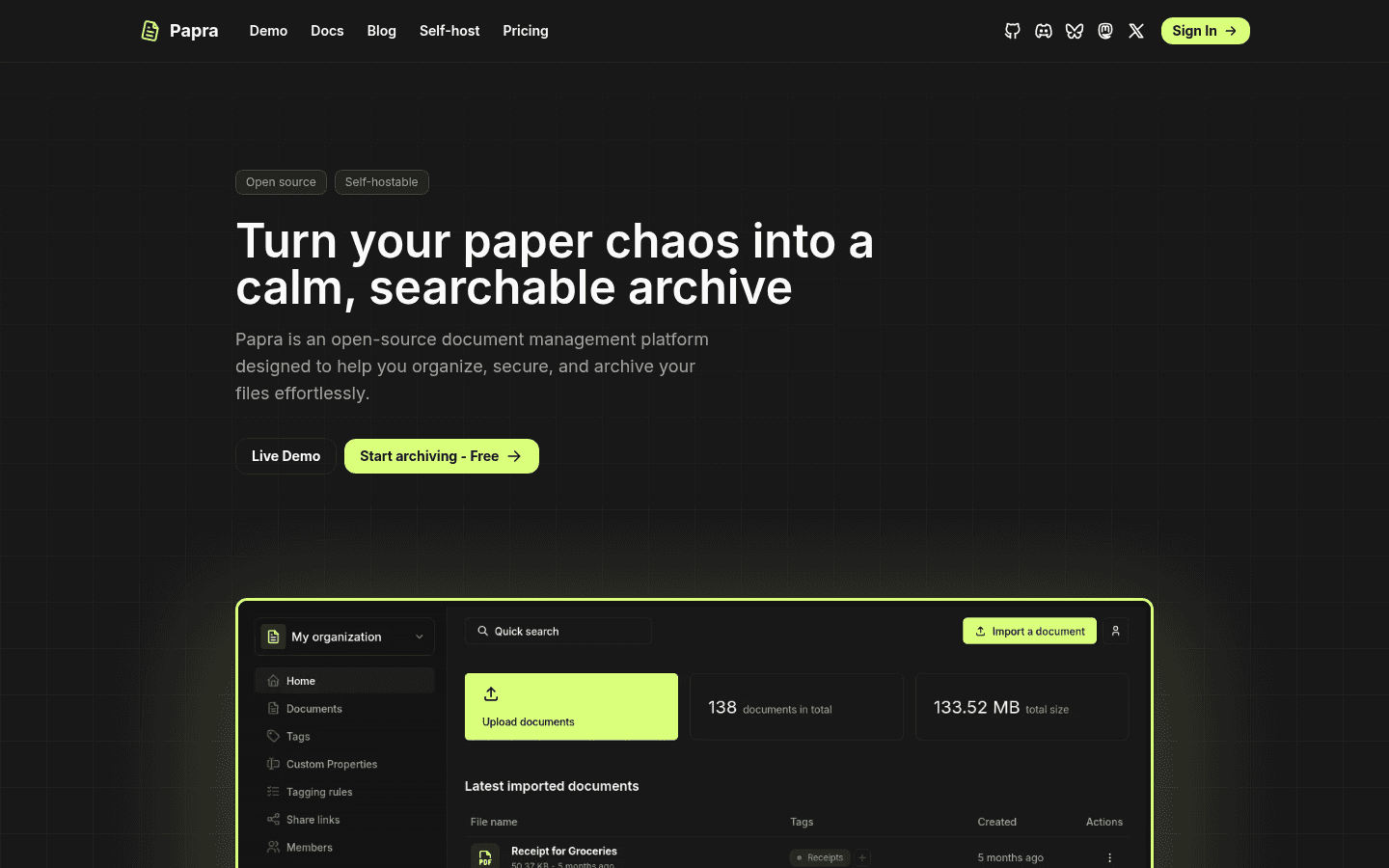
Screenshot of the public Papra website, captured for editorial review.
Product overview
How the product fits together
Papra turns scattered files into a searchable archive. Documents can arrive through upload, watched folders, email attachments, the API, or command-line tools. Tags and rules organize the collection, while extracted text makes scans and images searchable.
Platform surface
- Document ingestion
- Text extraction
- Tags and rules
- Search
- API and webhooks
Core journey
From entry point to outcome
- 01Create an organization and invite the people who need access
- 02Upload files or ingest them from email and watched folders
- 03Extract text from documents and scanned images
- 04Apply tags manually or through matching rules
- 05Search the archive and open the original document
Product capabilities
The functions that make the workflow useful
Multiple intake routes
Uploads, email ingestion, folders, API access, and a CLI support different document sources.
Searchable content
Text extraction makes the contents of scans and images available to full-text search.
Rule-based filing
Tags and tagging rules reduce repetitive organization as the archive grows.
Engineering review
What matters in a production implementation
Ingestion safety
Every intake route needs file validation, duplicate handling, and visible processing failures.
Extraction pipeline
Large files and OCR work belong in retryable background jobs with clear status for the user.
Retention and access
Original files, extracted text, shares, and deletion rules should follow the same organization boundary.
Independent public product study
This review is based on public product information. It does not imply that Papra is an Open Peak client or that Open Peak built the product.